World Record: A Review of Opoona (2007)
By H. K. Oubliette
Eugene Wang begins Shaping the Lotus Sutra: Buddhist Visual Culture in Medieval China (2005) with an articulation of his concept of "imaginary worlds"; his argument is that medieval Chinese "transformation tableaux" should not be analyzed simply as pictorial derivatives of the Lotus Sutra but as exercises in "worldmaking"—representations of the network of ideas and images behind medieval Chinese Buddhist culture. The Lotus Sutra informs this "world," but does not do so alone: every other aspect of medieval Chinese life now comes into play. Wang is interested in this world because it allows him to move away from what he calls the "post-Romantic assumption about the nature of art" (xxii) which thinks only in terms of the inventiveness of the genius artist and allows him to consider "social and religious-ritual functional constraints" on artistic production. The artist inhabits a world, and the hands of that world sculpt his masterpiece alongside him. Cynics, among whom I often count myself, may have that Wang essentially reinvents the anthropological concept of "culture": a field of ideation, norms, and values that is at once personal and shared, modified and modifying in feedback loops with materiality. What I find instrumental is Wang's gesture to spatialize this notion of culture: for him, a world “oscillates between a topographic entity and a mental construct" (xviii-xix). In his treatment of culture/mind (and, indeed, Wang discusses the closeness in Buddhist thinking of conceptual pairs such as "world and mind, cosmology and psychology" [xviii]) as a space, questions of proximity and extent come to the fore.
I would like to explore how the video game Opoona (2007), developed by ArtePiazza and published by Koei for the Nintendo Wii, captures the texture of such an "imaginary world"—an imaginary world only possible for a single moment in the 2000s, instantiated in a Japanese role-playing game.
Emmy-chan's Cartridge
What is a video game world, though? I have to talk about Emmy-chan’s cartridge. Emmy-chan was the lone daughter of a family friend. Her mom—my mom's friend—ran a Japanese-language immersion daycare that had taken care of my older brother and me. She taught my brother, who she was a bit older than, everything he knew about video games, so, via a process of interfamilial transfer, she basically taught me, too.
When she died—cancer, but I distinctly remember her mom telling me it was "stress" (that will really do something to a kid’s conception of overwork)—her family gave away a bunch of her belongings, and my brother received all her GameCube stuff because her younger brother, Shō-chan, like a model Japanese kid, was really more interested in baseball than video games.
When she died, it was sudden. Sick days piling up. Her mom was busy with the daycare work. By the time she could take her to the doctor, he could only hand down the devastating diagnosis.
When she died, they wood-framed a portrait of her, smiling ear-to-ear in her glasses and probably the pink shirt my memorialized version of her always wears, in the halls of Audobon Elementary School which we all attended, and I would see it during my various escapes from Ms. Chesney's kindergarten class. I spent pretty much all the free time I was permitted in Ms. Chesney's class reading the Nintendo DS manual for Kirby: Squeak Squad (2006)—front to back, then back to the front again; the controls, the various abilities and the types of items and collectibles, sprites and screens from the game—because it was the next best thing to playing the game.
The Kirby: Squeak Squad DS manual was something of a threshold—an interface between myself and the Kirby gameworld: a porthole I could look through, or a way I could inhabit the world for those times I couldn't play the game. For that one year I was at Audobon, one of my now-best friends could hardly get close to me (until we formed a band in middle school)—she says, because I was "always reading the Kirby manual." The habit continued, though, if not through Kirby through the Spore (2008) guidebook that had become its replacement by fifth grade.
I can probe my mind for memories of Emmy-chan, but I think I was too young to really know her like that. She had the Animal Crossing (2001) GameCube memory card with the introductory character, a black-and-red argyle sweater vest-wearing blue-and-white cat named Rover, on it. I always thought that cartridge was cool because it was black and red, too, and the red part was translucent.
GameCube memory cards came in three sizes: the grey Memory Card 59 stores 512 KB, the black Memory Card 251 stores 2 MB, and the white Memory Card 1019 stores 8 MB. Animal Crossing and Pokemon Colosseum (2003) required save files so large that, back then, when you bought the games new, they would usually come packaged with their own special Memory Card 59 decorated with illustrations from the game. Growing up, I wasn't allowed to touch Emmy-chan's old memory card—my brother guarded that thing with his life—of course, you can never trust your five-years-younger sibling to not overwrite what's on there.
Through the long process of growing up, which feels passive but is probably at least as active, I eventually became allowed to peer into that memory card without my brother's supervision: a sort of temporally-bound negotiation within the family domain. Emmy-chan's Animal Crossing save was more than impressive. In it lay a perfect town: 9-16 trees populating each non-exempt acre of the town's grid-based layout; a full arsenal of golden tools; a painstakingly filled out gallery and museum of bugs, fish, and fossils, including the rainy-day-exclusive arapaima; a tastefully decorated house by an interior-designally gifted 11-year-old. I've watched my own brother fuss over each square of his own town—a town my character, "[SPACE]Grizzly", had a house in; I would claim that the empty space at the beginning was to be read "Space Grizzly," but in truth it was a mistake that passed my limited childhood review abilities in character creation—going back and forth between the wishing well and the grid-square to ensure the correct tree-count per acre, trying to maintain a weedless, trashless expanse—ever-dreaming of that golden axe. I'd watched him bolt into action at the first sight of rain when the player-character exits his house, the drum-machine tones of the "Rainy Day" theme, to fish at the waterfall for the last absent member of his fish collection. Suffice to say the maintenance of an Animal Crossing (2001) town was a 'round-the-clock injunction.
The three of us (my brother, Shō-chan, and I) had homes in Emmy-chan's town—"Sapporo”—I remember "logging on" inconsistently throughout the years to weed and declutter the place in her memory. As our own characters, of course. Selecting Emmy on the player select menu gave the uncomfortable sense of reanimating the dead, of tarnishing a memory. “Sapporo”: if Emmy-chan’s situation was anything like mine, she didn't get to visit her mother's hometown all too often, and yet I imagine those moments where she did offered her a sort of liberatory peace that being away from home tends to provide, so much so that she'd want to inhabit it even as she was away from it—a migratory power conferred by the GameCube. Or maybe she’d never been in the first place, Hokkaidō’s snowy city built up as an internal mythic limit.
"Video Games" from 1965
Masuyama Hiroshi, in テレビゲーム文化論 (Terebi gēmu bunkaron, 2001), on the topic of the origin of video games, points us all the way back to Nam June Paik’s Magnet TV (1965). It’s a black-and-white television set, one of Paik’s tricked out “prepared televisions,” plus a big horseshoe magnet to distort the broadcast image: a work of sculptural video-art. One moves the magnet to manipulate the broadcast distortion into various forms. You see what Masuyama is getting at: screen, feedback, interactivity—inside we can unearth the wiry skeleton of a video game. Thomas Lamarre beautifully uses this as a departure-point in The Anime Ecology: A Genealogy of Television, Animation, and Game Media (2018): “the television generates spaces of play—we might also say sociotechnological fields of interaction” (151).
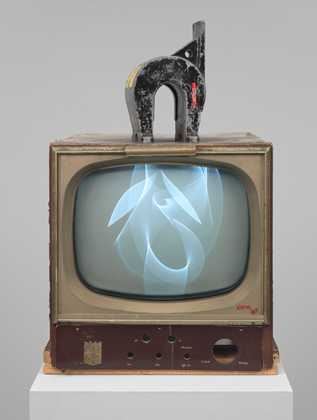
Much has occurred in video games between Magnet TV and Animal Crossing or Opoona. Magnet TV’s image is an event: it doesn’t remember how you fiddled with the magnet yesterday—it can’t even properly conceive of a “yesterday,” let alone a “tomorrow.” It lacks persistence; it accumulates no memory; the “world” insofar as one can be said to exist is only signal and its immediate visualization. Animal Crossing’s image, on the other hand, is computer scientifically stateful, boasting a set of variable parameters that are retained or continuously modulated from one moment to the next. Sapporo persists in our absence, grows weeds, villagers’ dialogue scripts inflected—infected—with worry. It remembers what you did to the world yesterday and allows those changes, their consequences, to survive tomorrow.
We got here on a spaceship. 1979’s Asteroids (Atari, Inc.) only remembers high scores. I looked it up and apparently Midway’s Sea Wolf (1976), the torpedo-shooting game, was the first to use the phrase, “high score.” Atari contributes to our chronicle of video game memory a continuous asteroid-field of play with a sense of spatial continuity as you drift and wraparound the screen. The world-state’s staying power, however, is weak. Restarting scatters the space rocks in all different positions and orientations; position at time of death has no bearing on the position of new life. Asteroids produces a continuous space newly instantiated upon launch, but space itself escapes memory. Arcade games were like that, of course: they remembered who did well, not what happened or where.
Warren Robinett’s Adventure (1980) for the Atari 2600 starts tracking object locations, player position, and puzzle states; you can resurrect and “continue” where you died, these variables left as they were. A stateful game, keeping track of these internal values even as the objects they point to are offscreen. But the prototypical world here eager to emerge is a fragile one: the game no longer retains state upon rebooting the console. The world may be continuous during play, but it collapses upon interruption. My wager here is to think of a world as not simply a space, but a return structure: a system of conditions under which a prior configuration of space, objects, and actions can be re-entered across interruption. However electrically precarious, Adventure offers us this kind of world. A world isn’t just the space in which play occurs, but the technical guarantee that a configuration of play can survive its own suspension.
1986 gave us Metroid and The Legend of Zelda. The former had passwords, and the latter had a battery-backed save system. World state is now persistent across play-sessions, albeit often externalized through things like passwords scribbled on tissues or napkins (notebooks and paper if you were well-prepared). Together with Adventure, this means in the 80s persistence evolved from scores and levels to explored areas, collected items, and altered environments. The much more convenient battery-save dominated the NES-SNES-N64 era, where the SRAM’s relatively fast, writable memory is contained in the cartridge with a small battery, keeping it alive through power-on and -off. Returning to the same world becomes technically guaranteed with battery-saves. Passwords, these external encodings, are no longer necessary as the game (or cartridge) itself guarantees continuity, the player now relinquished from the cumbersome demand of memory.
By the time Sony’s PlayStation and the Nintendo GameCube started retailing, persistence obtained the portable form of the memory card. Worlds are now detachable from the console and game. With this increased mobility, a social dimension peeks out: worlds can be transferred to other players, inherited after a death, protected for safekeeping, restricted from your annoying younger sibling. Unlike Paik’s modified TV, magnetic interference doesn’t affect flash memory.
The Archive as Return Structure
I read Orit Halpern’s Beautiful Data: A History of Vision and Reason since 1945 (2015) for a cybernetics class this semester. It’s good. She weaves together an intellectual history (that of Norbert Wiener and co.’s cybernetics) with its concomitant epistemological-aesthetic affordances plus a reading of Songdo International Business District (construction beginning in 2003, an artificial island off the coast of Incheon) which is basically a “smart city”: utterly horrifying—just about all biometric and behavioral data tracked, in service of providing a better “user” experience, with territory carved out on land stubbornly reclaimed from the Yellow Sea. The city as a platform of which the resident is but a “user.” She expounds about the emerging paradigm of archives, memory, and storage in the 1950s, coordinating an image of the archive as functionally much more than just a dutiful preservation of the past, memory as “an operative form of storage for further transmission and operations without any alignment to meaning” (69). Really quite a detailed and incisive analysis of the way the Macy Conferences and their causal environs have shaped the contemporary episteme.
The thing to remember about archives is they’re not innocent records of the past, but rather a machine that formats the conditions under which something can be accessed again. It’s a guarantee that something will be there the way you left it, the way you need to know it at that time. Halpern makes dubious the answer to whether the archive guarantees fidelity, truth, or verisimilitude; what it guarantees is repeatable access under specified conditions. It stores not the event but a structured possibility of its return—less a container and more a protocol. In this sense, historical archives, great libraries of past documents, are an organized network of texts that constitute a return structure for knowledge about the historical past.
In tandem, a GameCube Memory Card 59 appears to us now as less a miniature archive of past play sessions but more a device for enforcing returnability. It doesn’t remember what happened in Sapporo so much as it ensures that Sapporo can be re-entered, having awaited our return. What’s persisting is not the past, but the conditions of its reappearance. A video game world emerges in the tension between Magnet TV’s no-return and the GameCube memory card’s constrained return in physical space: a system that allows variation inside enforced consistency. Cloud or server-side storage of, say, player data, is still physical somewhere, after all, just externalized from the player’s concern, like how the battery-save obsoleted passwords. Data/space doesn’t appear to us out of thin air, but rather is mined from it by machines of our design. Songdo: when the world runs dry of raw material to transmute into economic profit, the obvious next step is summoning new raw materials (data of our perceptions, behavior, attention) from the ether of our social and physical being.
Airless Spaces
What’s with video game environments? My friend Robbie sometimes talks to me enthusiastically about the “architecture” of Counter-Strike (2000) surf maps, so I started thinking about it. In Lamarre’s earlier book, The Anime Machine: A Media Theory of Animation (2009), he introduces his concept of “exploded projection”: the anime image as a layered, composited surface. In his discussion of superflat art he says,
When the background does not look farther away than the foreground, your eyes cannot detach, isolate, and hierarchically order the elements in the image. Instead, your eyes follow the lines that zigzag across the surface. Such images are structured to encourage lateral movement of eyes. Eyes begin scuttling, meandering, scanning, as if restlessly oscillating around a center that remains nonlocalizable. This is superflat movement. (111)
Murakami (whose art I don’t even particularly care for) locates this in how viewers of anime “read” the moving image. VCR arrives in Japan with the Sony CV-2000 in 1965, but it is only with Sony Betamax (1975) and JVC VHS (1976) that the machine of recording-playback becomes widespread. Return becomes domestic, repeatable, owned. Fans can now record and ritualize rewatching: fast-forward, rewind, pause, exchange tapes, study individual frames. A 3D world like Opoona’s is similarly exploded—not just across the screen, but across a network of supports: the display, paratexts like game manuals and memory cards, and the player’s own acts of recall. The world is not given whole; it is assembled through these distributed surfaces of return.
Jun Hu, in “Narrative, Architecture, and Figuration in Mogao Cave 420” (in Visualizing Dunhuang, 2021–), notes that surface detail in sculpture—say, the textured rendering of a Buddha’s robe in stone—can interrupt or destabilize immediate figural readability. Texture does not decorate form; it competes with it, even reorganizes it. Color and pattern become silhouette. If we take 3D models in games as a kind of sculpture, the same logic applies. Textures—tiling, lighting artifacts, material maps—do not sit atop geometry but actively condition how that geometry is seen. And game space compounds this: UI overlays, repeated assets, uneven object and entity densities, all the so-called “seams” of production. These do not obscure an underlying coherent space; they are the conditions under which that space appears at all. In Opoona, there is no purified world beneath the surface noise. One inhabits a world assembled through it—through the constraints, shortcuts, and excesses of its making. What Eugene Wang calls a “world” is not an ideal spatial totality but a field of mediated perception. Surface detail is what memory later massages into legible form, but in the moment of play it is precisely what makes the world cohere.
Playing Opoona, with its playfully wacky 3D environments and imaginative futurist architecture, I found myself scanning from building interiors down to geometry surfaces much in the same way. Reading the visual environments of the game as art pieces that invite slow looking. Lately I’ve been reading Umesao Tadao, a Japanese anthropologist credited with bringing “ecological”-style thinking to Japan; in other words, the second-order cybernetic directive to consider not just an object but the network of associations (environment) that contextualizes it. In メディアと しての博物館 (Media toshite no Hakubutsukan, The Museum as Media, 1987), he says something like, “A museum is a medium that draws out the possibilities of the learners visiting it.” A gameworld is itself a museum, a container of all its buildings, surface textures, skyboxes, etc. Perusing and experiencing these digital objects draws out the possibilities not only of the player’s visual pleasure, but also affective satisfaction with the actionable world they implicate. The art director, Shintaro Majima, said in a 2007 interview with SPOnG that he had “always been interested in modern architecture and industrial design since [he] was in school.” His brother, Tatsuo Majima, is actually one such modern artist, responsible for designing the diegetic art pieces (discussed later) seen around the gameworld of its Earth-like planet, Landroll.
Henri Lefebvre’s La production de l'espace (1974) first gets translated to Japanese in 1975. In fact, a lot of Japanese intellectuals and architects are at this time reading this incoming French stuff about cities, architecture, and the production of space in the late 70s. Yoshiharu Tsukamoto and Momoyo Kaijima’s Tokyo architecture firm, Atelier Bow-Wow (アテリエ・ワ ン), is just one example. Atelier Bow-Wow’s Behaviorology (2010), aside from being a beautiful hardback gallery of their buildings to 2010, writes about architecture as behavior; designs as modulating, playing with or against the rhythms of everyday life, flows of such things as air, heat, water, electricity, trash, bodies, and traffic. In their practice, you can see that they’re very attentive to the balance between enclosed and open spaces (generally favoring open spaces). Most video games are all enclosed space. Everything is bounded by the limits of the gameworld. A town in Animal Crossing is small, strictly-bounded, gridmarked, yet feeling open as it supports variation over time. Routines microshift across repetitions as you walk around new objects and wandering villagers, as seasons change, as maintenance accumulates, as decay and worry abound in the longest of your absences. The affective experience of video game openness, then, is composed not just by quantity of space but by temporal thickness. A world feels open when it can absorb return without collapsing into sameness.
Re: Format
Jīchan died while I was writing this. When you’re that old, 90-something, your body is so fragile that any fall could do you in, and one did. He strolled around Kobe every day. I’m sure he had his rhythms too. He once told me never to try anything new, because what’s familiar is already the best. We thought he would keep chugging like this until 100 or something, every year getting those letters from his old chemical engineering job about which of his coworkers had died in retirement that year, grinning because he outlasted those old bastards. He apparently held a patent for a method of creating synthetic leather. He told me he hated all politicians except Gorbachev, showing me a video of the head of state disembarking an aircraft, greeted by the adoration of cheering fans. He didn’t have many friends at 90-something, all of them either dying or reticent to put up with his long lectures. I remember the nextdoor barber entertained his conversations in a sort of one-sided friendship. A family tyrant in his younger years, I have my fair share of negative experiences with him that indelibly complicate my memory.
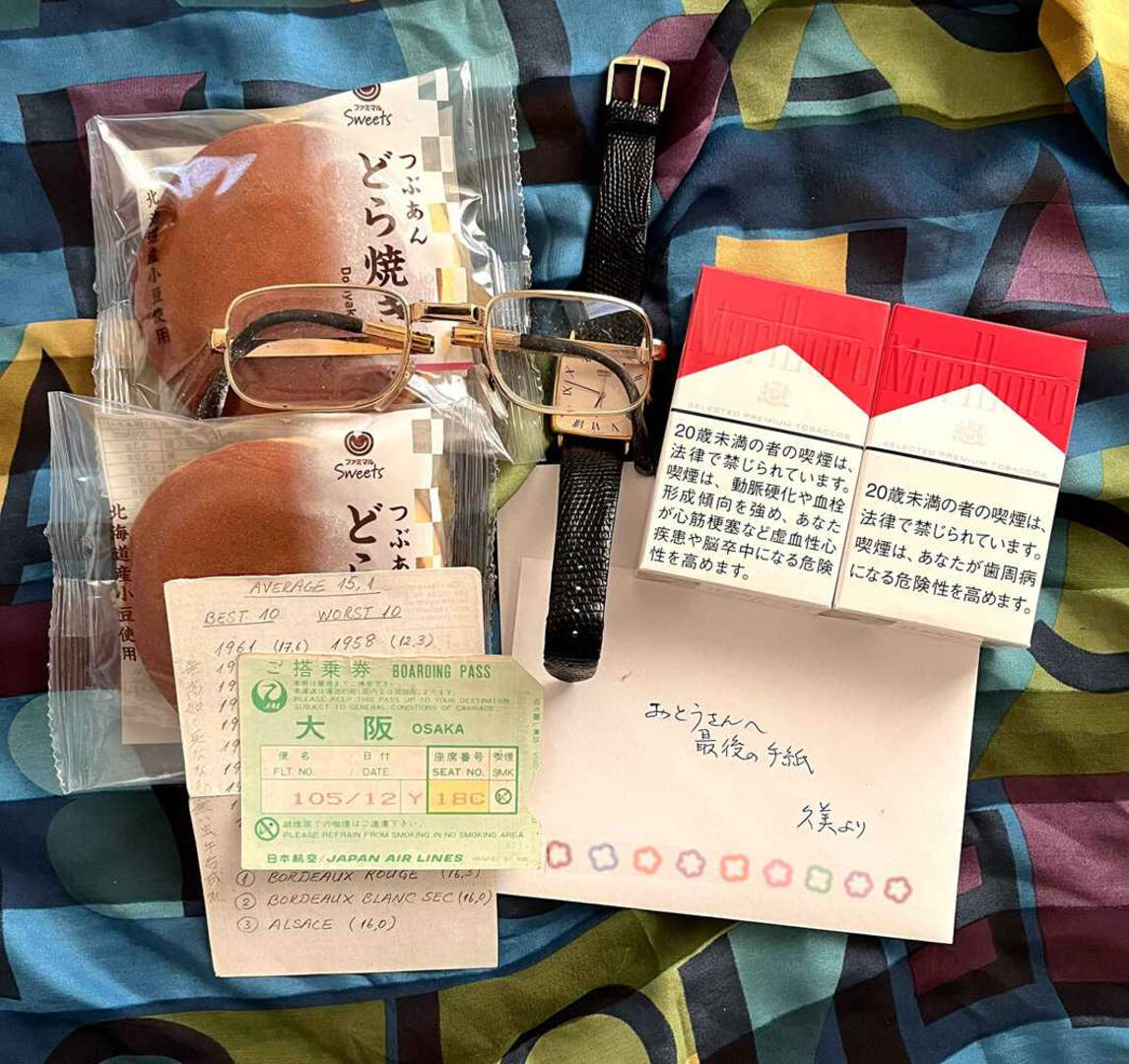
Two dorayaki. His wristwatch. A letter from Bāchan. A letter from mom. Two packs of Marlboros. His boarding pass from Japan Air Lines Flight 105. That’s what his body was burned with. His glasses still staring; staring at the news, the newspaper, Shimbun Akahata—the JCP newspaper he got because “it’s cheap”—staring at his past. In his old age began an obsession with leaving a legacy. His idea of a legacy was compiling our family history: in his study, sleeping at daytime, getting up to write at 3:00 a.m. (his light and movement disturbing us as we slept on rental cushions in the living room), his bilateral system of using two Microsoft Word (old versions at that) documents simultaneously—he updates the right with edits while cross-referencing the left. His own means of securing against memory loss. His version of staying sharp (Bāchan’s was cross-stitching and selling the products of her craft at the market). He visited faraway cemeteries and distant family, interviewing, figuring out the origins of our family name. Important shrines and graveyards which index the scattered remains of familial but not familiar bodies. Old migration stories that begin off the western peninsula of Shikoku, that tiny strip of land! He’d tell me something like, “I’m writing this so you can read it”; he knew nobody else cared. Mom and Bāchan avoided him to keep their peace. Mom always warns me of his use of archaic forms of the Japanese language, saying I won’t be able to read it. I should take a crack at it soon.
12 minutes after takeoff on 12 August 1985, the Boeing 747SR-46 flying the route designated “Japan Air Lines Flight 123” sustained “severe structural failure and explosive decompression,” crashing around Mount Takamagahara after half an hour of flight with weak control. Non-thorough maintenace as the diathesis and an unexpected tailstrike as the stress. The deadliest single-aircraft accident in aviation history. It was from Tokyo to Osaka, Haneda airport to Itami, HND to ITM. For Jīchan, it was from work back to home. On a whim, he decides to take an earlier flight. Same day, same route. My mom’s old man turned over these two flights in his head, finally deciding in favor of the earlier. Perhaps he wanted to see his family sooner. Or maybe it was less pathetic than that. Mom was 23, staying home with Bāchan after graduating college. A flight from Tokyo to Osaka just crashed, better tell your family you’re safe—someone must have informed him. Back at home, news of the accident flowed on daytime news. He calls, and sweet Bāchan asks, “What accident?” because she doesn’t watch TV.
Had he taken the flight and perished, Mom says, she would have canceled her then-prospective study in the U.S.—wouldn’t have met Dad, wouldn’t have had me. Wouldn’t have met Emmy, or video games, or written this. Jīchan kept the boarding pass for Japan Air Lines Flight 105 as his anzen omamori, his safety charm, until an evanescent encounter with Kobe-made concrete ripped his soul from his pitiful body in 2025. It seems morbid to keep a reminder of the deaths of 520 people, but he was just that kind of guy. My mom’s dad cheated death for nearly 40 years only to stumble from the street to the sidewalk—not the lifelong habit of smoking which he picked up again in old age when he decided it didn't matter anymore, and what has he got to lose? Not an infection from his falling-out teeth which his dentist commended him for outlasting. Fucking concrete. Peace, homie.
Once again, the family chronicle is more than just an archive. Not just what our family was, but a roadmap to returning to it. It structures legibility in advance, guaranteeing not truth but re-entry.
Cremation is different.
The body isn’t stored or archived. It’s processed, burned down—reduced to some fine ashen remainder sealed in an urn. And yet he returns. Not as he was, no, not as something that can be verified against a stored original, but his ghosts continue to organize our behavior: the documents he left, the obligation to read them, his former occasional penchant of recourse to physical violence from which we learned instinctively to cower, the paperwork burdening my mother as my grandmother lacks the sharpness and energy to deal with it (Mom has described death in Japan as a “Kafka-esque” bureaucratic nightmare). These things persist. A non-archive. It resists clean demarcation into memory, myth, or plain residue. Return, uncontrolled, booted by family photos, suspended only by distraction, fuzzes with the distinctions. A drive with no partitions, resisting formatting: FAT12, FAT16, FAT32, exFAT, but replaced in 1990 by NTFS on Windows XP. The OS I remember him using.
Opoona, for the Nintendo Wii
Nintendo released the Wii in North America on November 19th, 2006. But what was the Wii to the GameCube? Much has been written about the newly enrolled features of the seventh generation of video game consoles, and I won’t detail them all here. Most obviously, I want to think about the now oft-detested promotion and proliferation of motion controls. I mean, your body was always a controller, right? Our right and left hands coordinate to perform a continuous string of gestalt action-patterns comprising of button- and trigger-presses and sometimes very subtle control stick motions. We sediment these motor habits, executing them in perceptual chunks, timings feeling more and more like second nature as hours of play pass us by. The body isn’t a tool we use but the medium through which a gameworld appears to us as actionable. The body-controller machine assembles precisely to produce this effect. The purpose of a controller and a controller design are to compress this “embodiment” (in the anthropological sense) into fine motor schemas and microtimings.
Like our hands, the Nintendo Wii executes two parallel movements. It brings the body into the gameworld, and, at the same time, expands the gameworld into the real. In the former incorporation, the player’s bodily movement is taken up into the representational space of the game. In a movement like a Wii Sports (2006) tennis swing or bowl, the body is partially re-indexed as an in-game instrument. So, by impelling you to move your whole body, the Wii more expansively demonstrates that process by which we as players develop sensorimotor intentionality toward virtual environments. The latter movement is more like projection or territorial encroachment: the logic of the gameworld reorganizes physical space—your living room as a tennis court, a bowling alley. The field of action outside the screen gets restructured. To the control schema of the GameCube, the Wii is a recalibration of the interface between bodily habit and gamespace. Two modes of the body-controller machine emerge: traditional controllers produce a micro-embodiment: a tight coupling of high precision gesture to in-game action that’s largely invisible once habituated. The Wii produces macro-embodiment, a spatially extended, socially visible (even showy) mode of control that makes do with a less stable and more approximate mapping between gesture and action.
Opoona is a role-playing and life simulation game with a surprisingly deep combat system. At the moment of a random encounter, fancifully designed enemies spawn and scatter about a fixed battle environment. The protagonist character Opoona and his siblings hail from the planet Tizia; Tizians boast a floating orb either above their head or in place of their feet, utilizing it to attack by slamming this orb, called an Energy Bon-Bon, into enemies. Like pulling back a slingshot, the Bon-Bon flies away from the fighter in an arc to cull enemies (called Rogues) one at a time. Except it’s not necessarily one-by-one. Early in the game (around the second area, an agriculturally-based glass-domed city called Lifeborn), Opoona can acquire a Power Plus—one of various equippables that augment the combat experience (you can equip two coatings, which imbue your Bon-Bon’s strike with elemental effects, and three cores, which variously modify Bon-Bon stats and behavior; Power Plus is a core). How do you build your characters? Who do you target, and with which character? Attack, cast magic, or heal with an item?
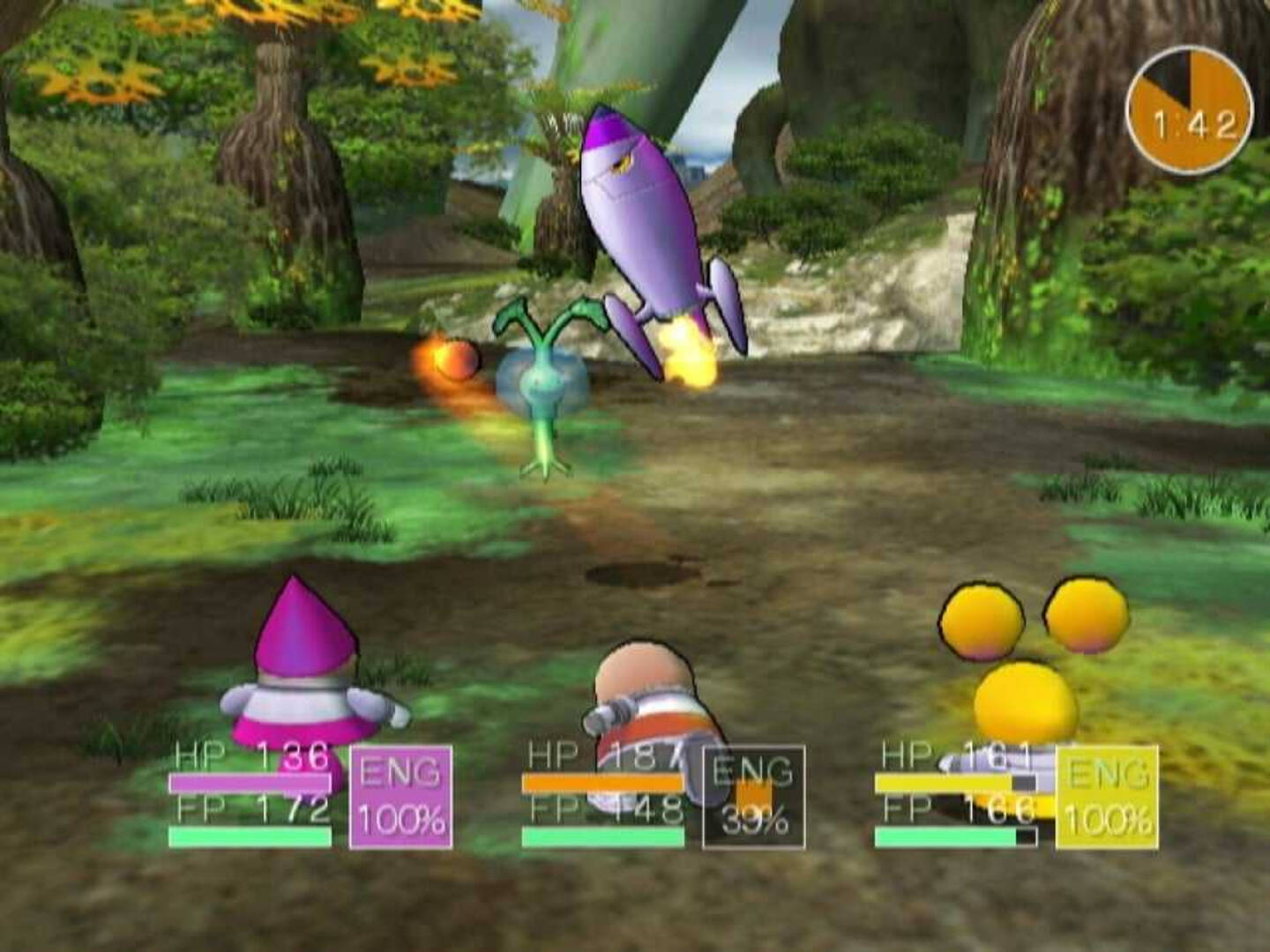
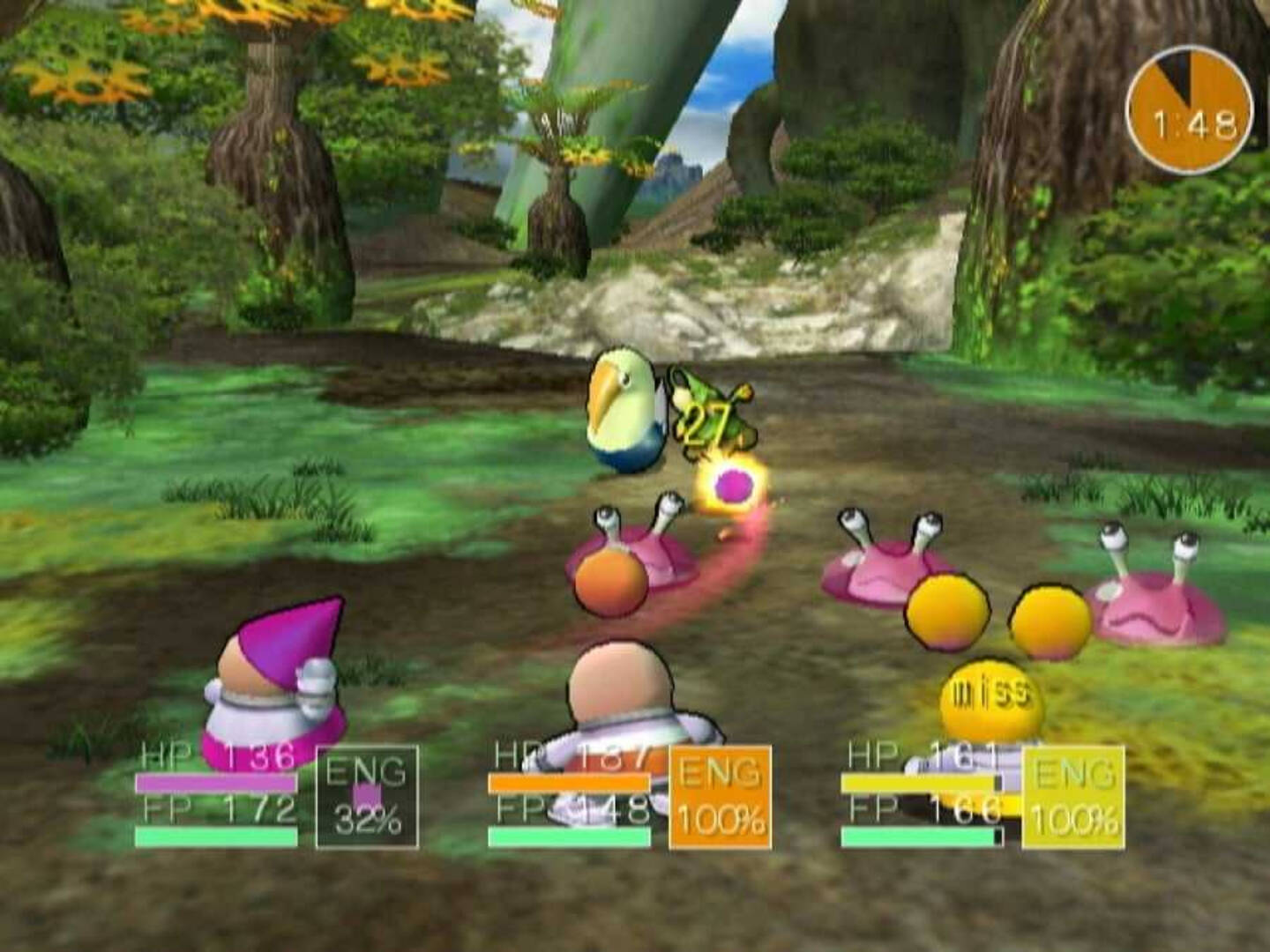
Power Plus changes everything to the point that most players will have at least one of their core slots reserved for it regardless of their surrounding build. Many cores augment various Bon-Bon stats like power, luster, impact, weight, luck, endurance, health, mass, solidity, and hardness, but there are a heaping handful of cores that confer miscellaneous effects. Power Plus allows your Bon-Bon to smack through more than one enemy. Suddenly, this slingshot-aiming game of curving your Bon-Bon around obstacles to wallop a specific enemy of your choosing becomes more like a bowling game where you attempt to opt for the trajectory that will collide with multiple baddies to distribute as much damage as possible. The tactile satisfaction of executing a “strike” braids with the RPG-veteran’s instinct to soup up your Bon-Bon with your choice of equips—at certain thresholds of power, you might even knock out every enemy along the itinerary you launch your Bon-Bon along. This system enforces the RPG’s ludic loop as you pace back and forth from equipment shops to battles, toying with builds in your gamic laboratory. This gestural combat system, called the “Active Bon-Bon Battle System” in-game, is exceedingly enjoyable in high-risk scenarios where you find yourself needing to pitch the most precise of curveballs. Not long after showing you the ropes of its combat, Opoona avails you to a complete upside-downing of the mechanics with Power Plus.
ArtePiazza had a very accepting system into which they could intuitively incorporate the Wii’s new glamorous motion controls. They didn’t. You fling the Bon-Bon by tilting the Nunchuk control stick one way, and it whips through the air in the opposite direction at a speed and power proportional to how hard and long you held the stick back. The Wii’s fledgling macro-embodying motion controls lacked the fine motor precision to produce the satisfaction of good execution produced by this thumb-motion. This refusal is glorious. Where the platform of the Nintendo Wii culturally promised macro-embodiment, Opoona stubbornly adheres to a conventional control schema even in contexts where gesture-mapping seems obvious: A GameCube control scheme on a Wii game. ArtePiazza issues a challenge to what the Wii seems to culturally demand by deploying a previously established convention, repurposing the act of remembering by turning to an older iteration of the body-controller machine. Opoona doesn’t need the gaudy motion controls of the Wii to ensconce the player within its gameworld—it does so through snappy semi-realtime combat (turn order of the party cycles from one character to the next, according to the speed at which their individual energy meter, itself stat-dependent, recharges after a shot) and a polyphony of different temporal rhythms that structure life in the simulation game.
World Record: A Review of Opoona (2007)
I asked my brother if I could bring the Wii I modded to where I live now. He said, “Sure, if you mod the other one for me.” I said I would, but I didn’t. Modding a Wii is a bit more involved than modding a 3DS, sure, but it’s doable if you stick close to the guide. I was midway through Opoona when I moved and was partway through setting in place the theoretical lodestones of this review. I unpacked the Wii, its power cable, the best Wii Remote and Nunchuk we had at home, the sensor bar, bought Duracell’s double-A batteries, and waited patiently for the capture card that would allow me to output the Wii’s video to my Framework 13 laptop screen to arrive in my mailbox.
I played Opoona because Yvette said its inimitably inspired character designs indelibly altered her aesthetic sensibilities since childhood, so, going in, I treated it like a gallery or museum: a several-course sampling of various visual ideas, each one my eyes devoured with a voracious tenor. The Rogue designs were indeed sick:

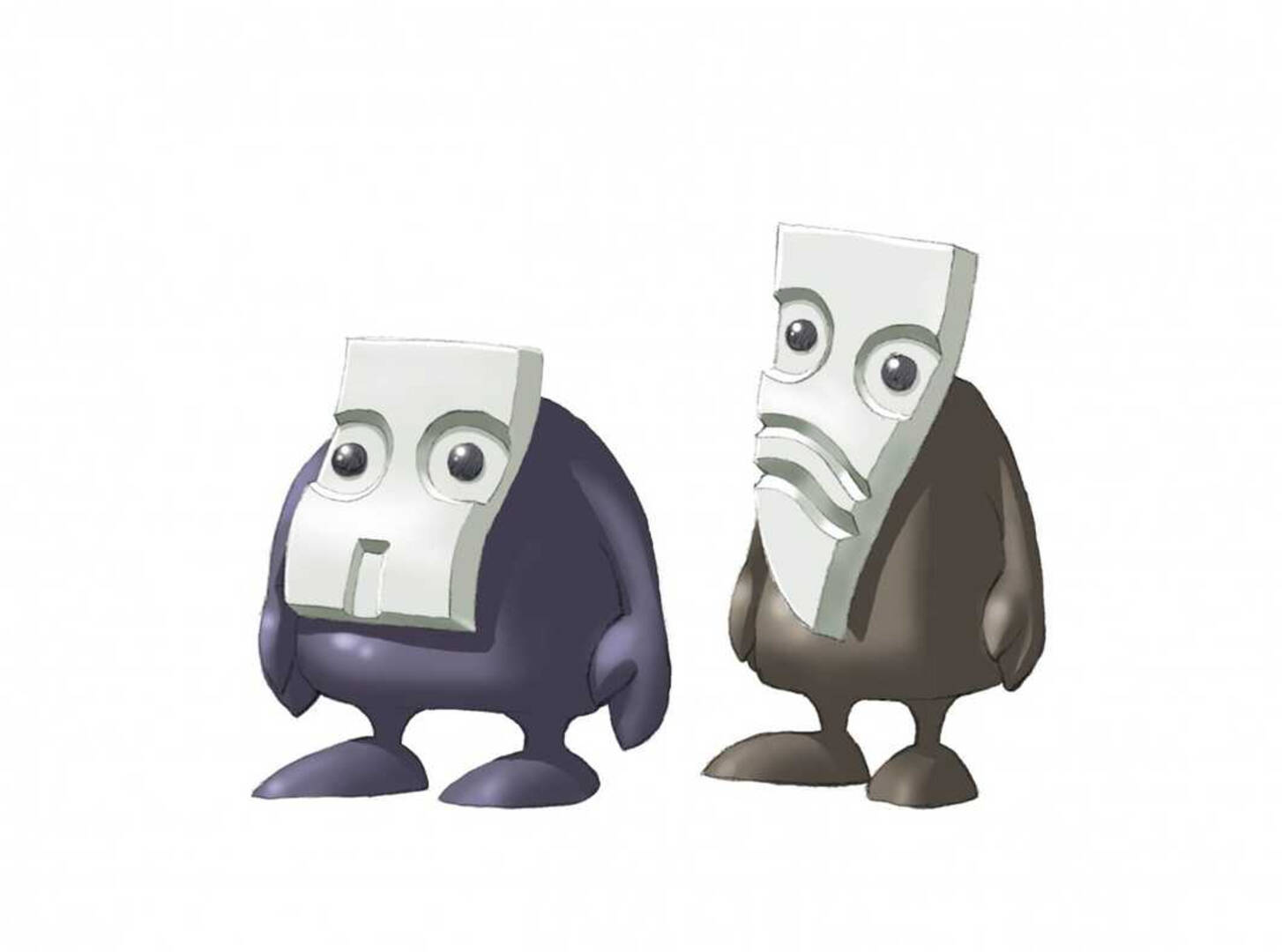
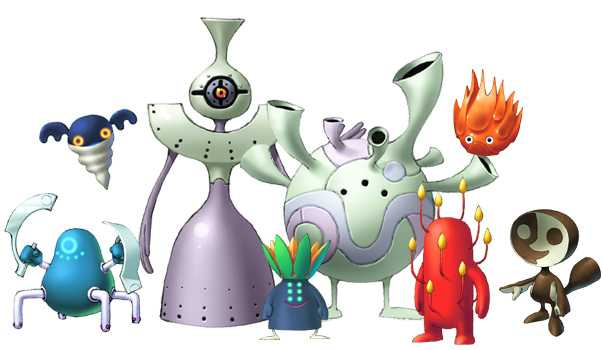
The sprites for this game are nowhere near exhaustively uploaded, and there are many other interesting designs.
Struck by a mysterious accident on an interplanetary family vacation, the Tizian boy Opoona crash-lands onto Planet Landroll, separated from his siblings and told that his injured parents are in the care of the Sages, a class of distant healers. Landroll is divided: domed cities sustain a managed, orderly life on the planet’s light side, while the dark hemisphere—the Deadlands—hosts the remnants of a prior catastrophe and the proliferation of hostile Rogues. In exchange for the promise of familial reunion, Opoona enters the bureaucratic and martial structures of the world, taking on the role of a ranger.
What follows is less a linear quest than a circulation through systems: work, licensing, friendship, and combat. Its ludic flow plugs each city into the next—agrarian Lifeborn, aesthetic Artiela, the living computer of the Intelligent Sea, etc.—presenting not just new spaces but new rhythms of repetition. The game’s narrative unfolds not through dramatic rupture so much as through sustained inhabitation of these loops, where the strangeness of Landroll emerges gradually, almost ambiently, from the routines it demands.
Opoona allows for jobs ranging from fast food service to pop music idol, multistage friendships with quirky characters, and a proliferation of diegetic artworks, each belonging to its own invented movement. Charming dialogue circulates through NPCs, quests, and TV episode broadcasts which differ from city to city.
In Landroll, lifetimes are organized around a finite quota of labor: work long enough, and one earns passage to the Sanctuary, a space of total provision where all needs are met. This arrangement, devised by the Sages, initially presents itself as benevolent, even utopian. But as Opoona moves through its institutions—taking jobs, acquiring licenses, forming relationships—the system begins to register differently, its promise of completion shadowed by a quiet unease. The narrative escalates toward a grand conflict as it gradually discloses the latent tensions between those who inhabit this managed world and those relegated to its untamed margins. Opoona’s coming-of-age unfolds within this structure, less as a moral lesson about family or friendship than as an attunement to the conditions that make such bonds possible at all.
Landroll’s domed settlements are experienced less as spaces to be traversed than as circuits of return—shops re-entered, routes re-walked, menus reopened, bureaucratic procedures repeated until they settle into familiarity. The game builds temporal thickness: a density produced not by scale but by recurrence. Opoona is always embedded in the maintenance-progression loop—inventory, relationships, incremental stat adjustments—that slowly sediment into capacity.
In this sense, Opoona’s embodiment arises not from the Wii’s promised gestural interface but from habit. You learn the arc of the Bon-Bon against particular enemy formations, the timing of charge and release, the cadence of healing and retreat. Inputs cease to register as discrete actions and instead become durations folded into reflex. Opoona is not primarily about moving through a world but about sustaining continuity with one. Its life-sim systems, combat loops, and spatial design converge on a single principle: experience is produced not by novelty, but by the controlled return of action across time.
The invented art movements scattered across Landroll—Revolvism’s insistence on rotation, Standardism’s fixation on size, others—are easy to read as jokes, or as whimsical set dressing. But they do something more consequential: they stage in miniature the very conditions under which art becomes legible as art. Each movement articulates a constraint, a principle of selection, a way of organizing perception. In this sense, they are not unlike real-world movements, which likewise delimit what counts as form, intention, or value. Umesao Tadao’s claim that the museum functions as a medium—one that “draws out the possibilities of the learners visiting it”—is useful here. Landroll operates similarly, but more aggressively: it does not simply present objects for appreciation, it embeds the criteria of their appreciation into the space itself. Its architectures, interiors, and artworks form a continuous field in which perception is already guided, attention distributed, judgment preconditioned. What this makes visible is that evaluation is never external to a work but arises from the structured relations it establishes. If we take those relations seriously rather than bracketing them as fiction, the distinction between “game art” and “real” art begins to erode. Opoona’s world does not imitate artistic discourse; it produces one. And in so doing, it demands to be evaluated on the same terms: as a constructed environment that organizes experience, perception, and judgment.
When you prove victorious in the game’s final bout, your build stabilized and your relationships selectively cultivated—pleasant ending watched—temporal progression ruptures. Upon reloading, time folds back on itself: the world resumes just prior to completion, offering the chance to re-enter and reconfigure what had seemed resolved. This is not postgame content so much as a formal statement. Opoona refuses closure in favor of persistence, preserving the world as a field of possible returns rather than a sequence that can be exhausted. Completion does not end the world; it exposes its structure.
Multi-game speedrunner Woalds beat Opoona Any% in five hours, nine minutes, and thirty-four seconds on April 4th, 2026, noting suboptimal RNG and a small time save from the fishing subgame. I don’t even think they relied on Power Plus in the late game, opting instead to minimax single-target damage. A different route would have produced a different time; a different time, a different world. Opoona is of course not unique in permitting this variability—but it makes contingency structural. It does not simply allow for divergent play; it insists that the world itself is a function of those divergences. The player as Tetsu Inoue’s world receiver. A world record. The accomplishment might last, and it might not as runners seek better times. A world recorded. Yes: one in which I remember you.
Heavier Than a Death in the Family
It’s a few months ago, winter break, in the car with my older brother, driving back from Sea-Tac airport. I was writing this. I asked him what Emmy-chan was like. He said she was always nicer to him than to Shō-chan, despite my brother being younger, more insufferable. Shō-chan works in software now, I think. I asked him about Emmy’s Sapporo, if it was impressive. Do you know what he said? He said, “not particularly”: she didn’t play the game that seriously, and for whatever it’s worth, her home and, indeed, her town, looked like an 11-year-old had put them together. Fuck. Writing this across several months, I had to confront a severe instance of my misremembering. This was supposed to be a double-review, where Yvette reviews Opoona from childhood memory, and I review her review while supplying my own, having recently beaten it. Those plans fell through, though, because Yvette ultimately said she didn’t remember enough about Opoona. Incomplete memory, false memory. Like Opoona’s iconic-creative character and enemy designs lastingly impressing upon a Yvette only scantly remembering the game or how she played it, these dubious memories of Emmy-chan’s perfect world had taken on a meaning of their own, had been mythologized.
But false things have a lot to tell us about what’s true. The historian Reinhart Koselleck has a chapter, the twelfth chapter, called “Terror and Dream: Methodological Remarks on the Experience of Time During the Third Reich” in his book Futures Past: On the Semantics of Historical Time (2004). In it, he gives an account of a German doctor, who recounts a dream he had in 1934 where, “around nine in the evening … suddenly the walls of my room and apartment disappear. Appalled, I look around: all apartments, as far as the eye can see, no longer have any walls. I hear a loudspeaker bellowing: ‘in accordance with the decree of the seventeenth of the month on the abolition of walls’” (209). This never happened. But, after all, the verisimilitude of a memory to the real facts of the world have no bearing on its role in organizing psychic life—much like a dream, the most important aspect of a memory is the fact that you have it. So I kept that paragraph about Emmy’s perfect savefile, because there is no stable center to memory—it oozes its affective residue, licking and coating everything we touch.
A couple years ago now, visiting my extended family (my second cousin, his dad—my once-removed first cousin) in Tokyo, I approached the butsudan or in-the-family-home Buddhist altar to light an incense-stick for their late grandfather. He had died the previous year following a bicycle accident—I had just missed him with my trip. These funerary rites allow a sort of tending-to of our (shared or private) memories of a person. Like weeding. I’m sure his ghosts loomed over their family, too.
Here's the rosy-cheeked white pig villager, Lucy, proudly showing off a letter Emmy wrote her through the in-game postal system—is it just us on this side of the television set that remember her? Maybe, and then again, maybe not. Is it memory or residue? I haven’t touched that Rover Memory Card 59 in ages. Sitting in a basket filled with miscellaneous controllers, cables, and peripherals. The town inside more than likely overgrown with weeds by now.
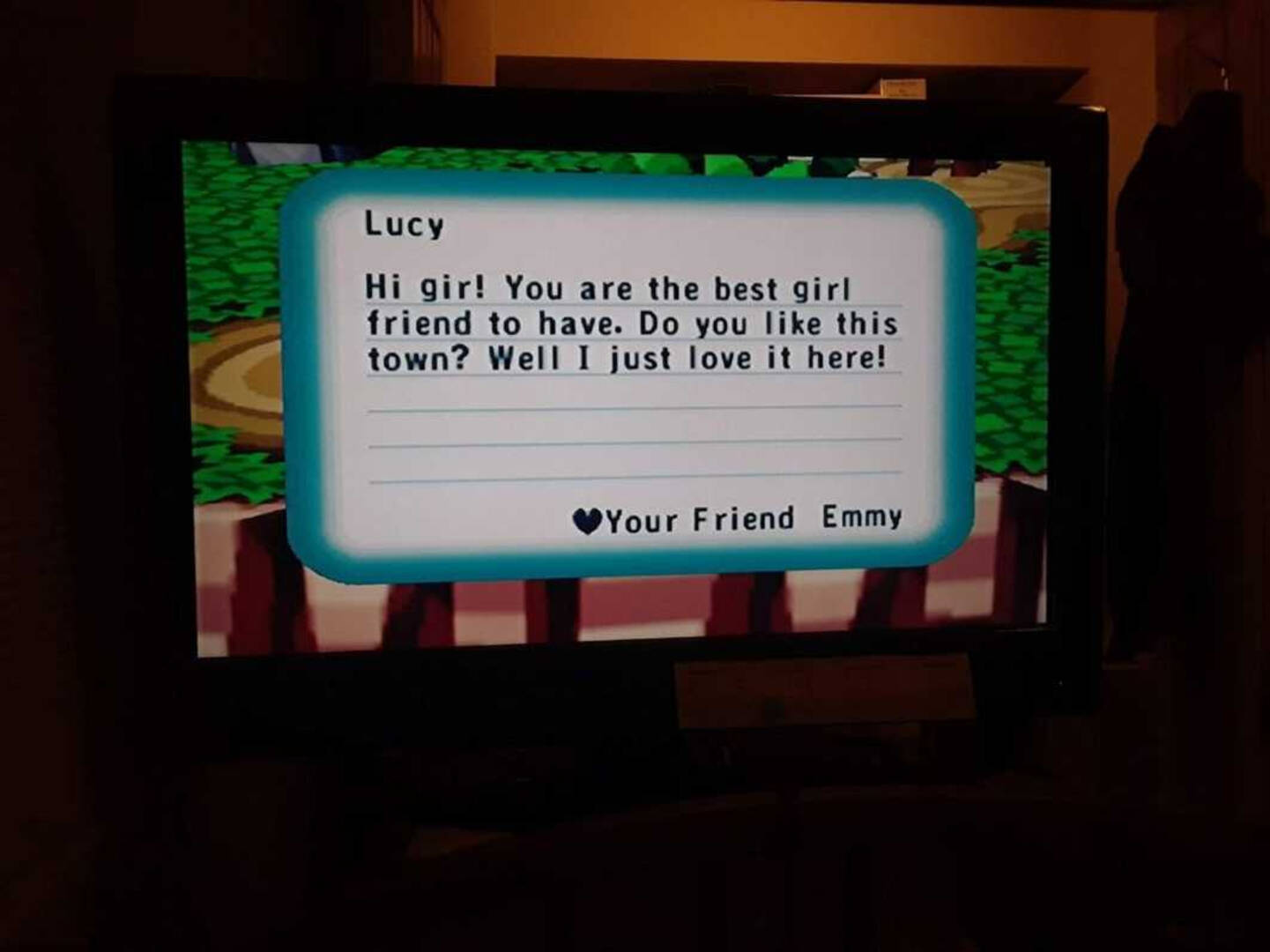
A game world does not preserve what happened. Perhaps it does something more akin to selective forgetting. Sapporo is still there—not as it was, but as something that can be returned to, misremembered, reworked, resumed. Like Opoona’s suspended endgame, like a family archive: not memory as record, but memory as a structure of return. But the structure is unstable, disintegrated from the corporeal body it once was, into ash, into urn, and we collect these impressions throughout the flying arc of a life. And I keep turning you over in my mind, wincing each time you come back. Opoona (2007) helped me put you to rest in the rhythm of remembering-forgetting.
It’s been a long time, Lucy. I’m good, I’ve just been busy. Lot going on. No, Emmy’s not back yet. Could you water the flowers for her?
Then again, I could serve to visit Sapporo more, too.