wiki/電波系 translation
translator's note
the japanese wikipedia page for “denpa-kei” is more detailed than its english counterpart. the version as of march 1st, 2024, is translated here as an object of reference for future research. the original page can be found here. the translation style often favors literal word meaning and original syntax, sometimes at the cost of readability, and thus intentionally retains some formal characteristics of machine translation. justifications for this style may or may not be outlined on this site at a later date. hepburn romanization is used
“related media,” “footnotes,” “works cited,” and “see also” sections are yet to be translated and will be appended later. thank you
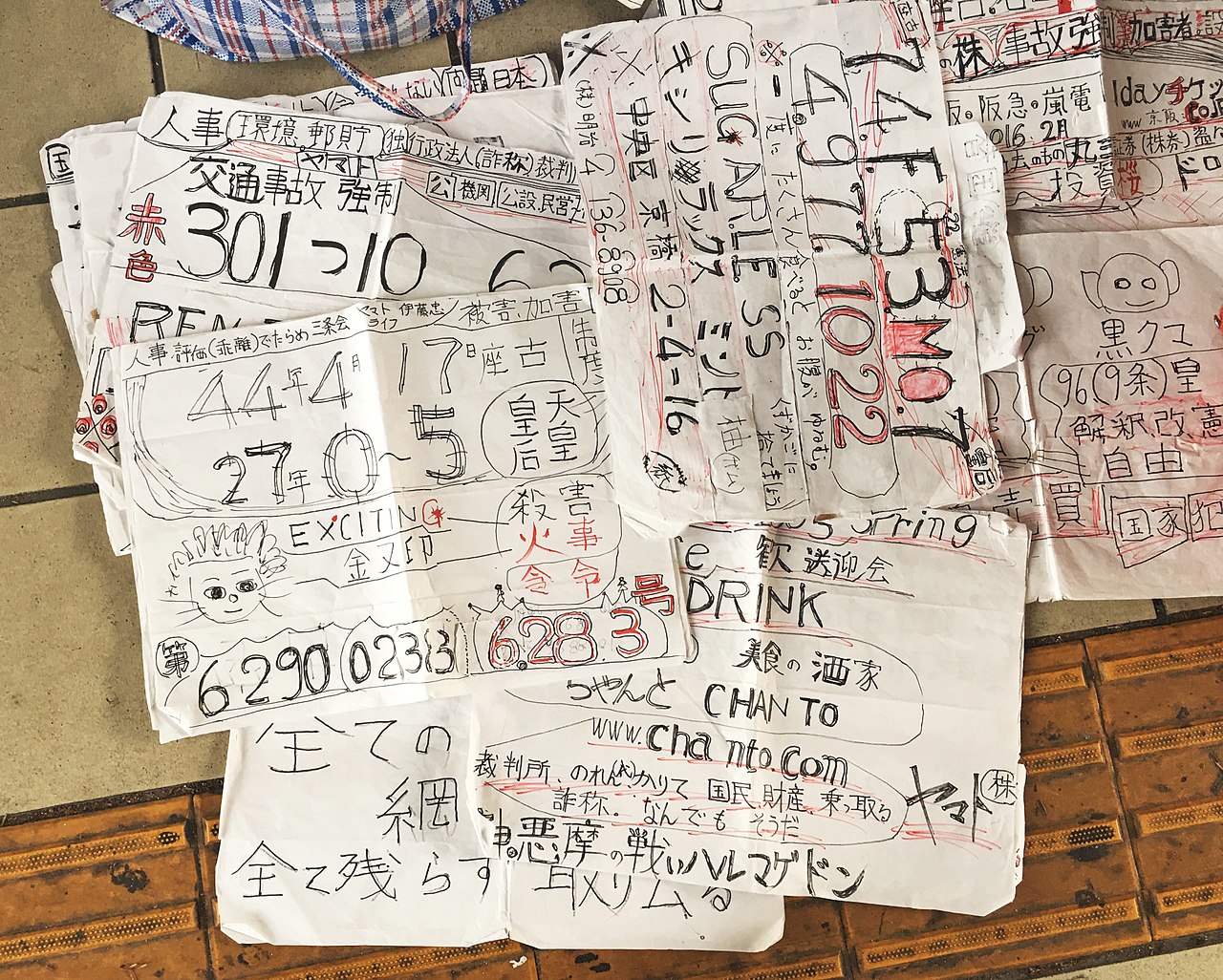
Leaflets that circulate one’s incoherent positions and principles are called denpa-bira [“denpa flier”]/denpa-bunsho [“denpa document”], often mixed among posters on public property and fliers handed out in front of stations. (Photograph around Kyōbashi station, Osaka Prefecture, from 2016 October) The incoherent positions and principles typically circulated by denpa-bira. Denpa-bira with “captive of daily life” written on them formerly distributed in Tokyo Metro Ginza Line by a woman called Minato Akiko (Minato Masako); inspired by this, the eccentric manga author Nemoto Takashi popularized these words through the column Jinsei Gedoku Hatoba [Human Life Detoxification Harbor] serialized in Takarajima 30 and the book Yakanchuugaku Torikojikake no Yo no Naka wo Ikinuku Tame no Nyuu Tekisuto [New Text for Surviving a World Imprisoned in Evening Middle School]. [Evening middle and high schools allow truant students to receive an education after hours].
Denpa-kei
Denpa-kei [denpa-style] is a slang term used to refer to people who declare absurd delusions or claims to people around them. It may elsewhere be written 電波 [denpa, kanji for electricity + waves], デンパ [denpa, katakana], or デムパ [demupa, katakana].
Transmission and reception of radio waves [denpa] may be expressed with onomatopoeia such as yun-yun, yon-yon, yan-yan[1].
Outline
Originally, denpa-kei referred to people who speak of hearing voices, thoughts, instructions, interference, etc. from someone or something being transmitted to their head via radio waves.
Those who exhibited symptoms of such persecutory delusions (frequently schizophrenics) in the age before radio waves were commonplace were thought to be affected by animals or spirits or called kitsunetsuki [possessed by a fox spirit]. The claims that oneself or one’s environment is being manipulated by radio waves begin with Showa-era modernization where devices receiving and transmitting radio waves came to be placed nearby, accompanying the development of technology that transformed [message] sources, as in “radio waves from radios” or “radio waves from television.”
In recent years, conspiracy theoretical claims such as “a listening device has been planted in the room,” “thoughts are being manipulated by wireless communication,” “[I am being] watched through the internet,” “[I am being] controlled by a microchip/RFID planted in the head” have also been seen.
Also, since the latter half of the 1980s, the effects of electromagnetic waves on the human body have been questioned; especially, effects to the head and brain have been suggested[2]. Concurrently, as nearby devices emitting strong radio waves such as microwave ovens, household appliances utilizing electromagnetic induction, mobile phones, etc., overflowed [in society], people claiming [they were being] attacked by electromagnetic waves (electromagnetic hypersensitivity; EHS) began to appear[5].
The “denpa” that expresses such persecutory delusions became popularly known in 1981 (Showa 56) when the Fukugawa Street murder case culprit testified that his own conduct was “ordered by radio waves”[6].
Mostly, the popularized usage of the terminology, “denpa/denpa-kei,” does not follow such a strict, medical definition (like diagnosis of schizophrenia), rather being used for people who express strange claims or take actions not complying with societal common sense.
The usage of this meaning of denpa-kei is used in subcultural and otaku-kei media as a common expression, such as Takarajima 30 [Treasure Island 30] and Bessatsu Takarajima [Separate Volume Treasure Island] which reached out to denpa-kei people and continued long-term exchange [of writing], published by the Takarajima editorial department [Takarajimasha, Inc. publishes subculture magazines]; the eccentric manga author Nemoto Takashi’s, who, taking denpa-kei people as not only a domestic phenomenon, sought them out in South and North Korea; and allegedly tormented by such symptoms himself, the kichiku-kei [brutal-style] writer, Murasaki Hyakurou’s[7] activities exist in the backdrop.
Denpa in Media
In the 1936 classic Japanese SF work, Uchuu no Kanata E [To Yonder in the Cosmos] (Nishimori Hisaki), tanks use “harmful radio waves” (dokudenpa) to drive away enemies[9].
During the 1970s shortwave listening boom, Nikkei Ryuutsuu Shimbun (presently Nikkei MJ) and Nikkei Koukoku Techou [marketing journals] popularized the term koukando ningen [high-sensitivity human] in the advertising world[10]. Spring 1977, Seibu [holding company] took this and published an advertisement saying “How about high-sensitivity? Beep. Beep”[11].
Though the September 1980 issue for manga author and illustrator Watanabe Kazuhiro’s Garo [monthly manga anthology magazine] announced Dokudenpa, a manga production where “people suffering from attacks of radio waves” appear (manipulated experiences)[12], not only stories of the side sustaining harm, but denpa representations of the manipulating side, where radio waves are used to control others, also appear. After reading this manga, the eccentric manga author Nemoto Takashi, surprised having met people who had actually sustained attacks of radio waves, popularized the existence of radio waves in his own work[13].
In David Cronenberg’s published in 1981 film Scanners, the protagonist “scanners,” forced to hear others’ thoughts inside their brains as a side effect of sleeping pills for pregnant women [taken by their mothers], are able to possess others’ nerves by concentrating their consciousnesses, control their actions, and even destroy electronic devices through telephone lines. The use of these “controlling others”/“assault method” denpa, rather than the passive, “suffering damage” kind, was adopted into the literary works of Japan.
Musician and writer Kenji Ohtsuki represented these radio waves in many of those works, giving various influences. Also, Ohtsuki used “denpa” in song lyrics and titles of [his band] Kinniku Shōjo Tai in the indies era, and incorporated “denpa” in musical compositions such as “Mousou no Otoko” [“Man of Delusion”], “Denpa BOOGIE,” and “Kurukuru Onna” [“Kurukuru (onomatopoeic word for revolving) Girl”] after debuting in majors [major record labels]. Likewise, the transmission source of radio waves, the antenna, debuts in “Shaka” [“Shakyamuni”] and “Boku no Shuukyou ni Youkoso” [“Welcome to My Religion”], frequently used in expressions entwined with denpa experiences. Particularly, in Ohtsuki’s published in 1992 novel, Shinkou Shuukyou Omoide Kyou [“New Religion Memories School”], identically to the “control”/“assault method” in Scanners, depicted a story where “megumaha” [“blessed waves”], radio waves that induce mental disorder in others just by wishing it, are used to clean up adversaries.
Stimulated by Ohtsuki’s Shinkou Shuukyou Omoide Kyou and “Kurukuru Dukai” [“Kurukuru User”], a bishōjo game called Shizuku [“Droplet”] based on Takahashi Tatsuya’s script was published in 1996 January[15]. Within this story, the power to induce thought control is expressed as dokudenpa[16]. Bringing a form of expression that can be called novels with active [reader] choice into the R-18 bishōjo game business world, giving large influence to the business world, the word dokudenpa spread to mean that which can control others’ thoughts/destroy cranial nerves at will, turning the target denpa-kei[18].
As something that blocks against thought denpa/control from others, Julian Huxley’s 1927 The Tissue-Culture King suggested that wrapping one’s head in metal could act as a telepathy-blocking guard; modernized as wrapping one’s head in aluminum foil, the “tinfoil hat” stuck as a symbol indexing denpa-kei people in Japan.